Peptide · Growth-Hormone Support
Sermorelin
A GHRH analog that asks your own pituitary to release growth hormone on its natural nightly schedule — rather than replacing the hormone from outside.
Available by consultation
What it is
GH Support
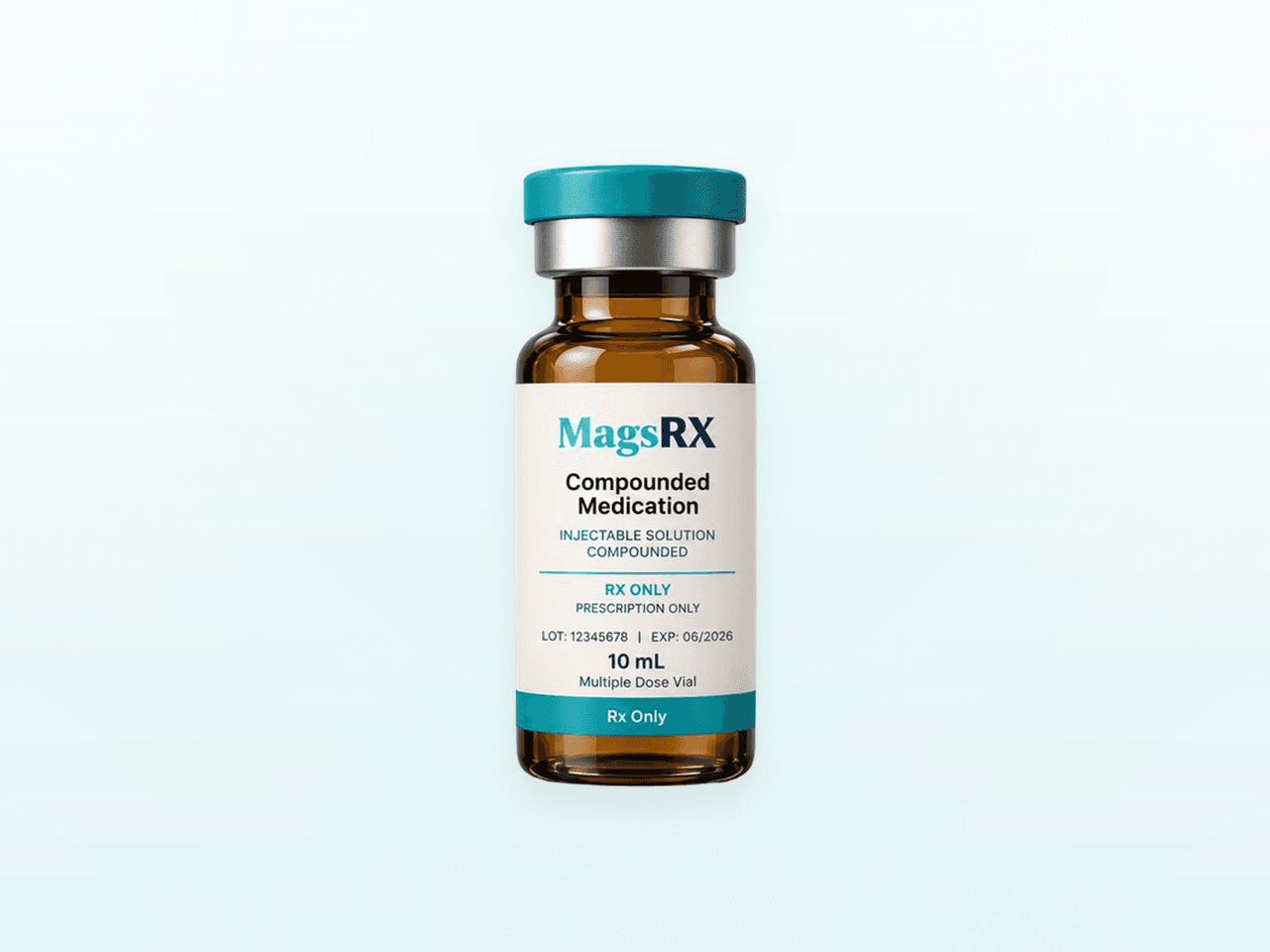
Sermorelin is a compounded peptide built from the first 29 amino acids of growth-hormone-releasing hormone (GRF 1-29) — the shortest fragment that still carries the full signaling message. Rather than introducing growth hormone from outside the body, it prompts the pituitary to make and release its own, so the hypothalamic feedback loops that keep levels in range stay in charge. Because that signal normally crests during deep sleep, Sermorelin is most often used to support restorative rest, recovery, and the sense of vitality that can soften with age.
Sermorelin works one step upstream of growth hormone itself. It speaks to the gland that produces it, so your body keeps deciding how much to release and when.
Docks at the GHRH receptor
As a GRF 1-29 analog, Sermorelin binds the growth-hormone-releasing-hormone receptors on the anterior pituitary — the same docking site your own GHRH uses to initiate a release signal.
Prompts a pulse, not a flood
Instead of raising a steady background level, it cues the pituitary to secrete growth hormone in a discrete pulse, ideally timed to the slow-wave sleep window when the largest natural surge already occurs.
Feedback stays in charge
Because the hypothalamus and pituitary still govern the loop, somatostatin and rising IGF-1 can taper the response — so release reinforces your own regulation rather than overriding it.
Candidacy
A considered fit, not a funnel.
Sermorelin tends to suit adults who feel their sleep, recovery, and edge have quietly dulled with age, and who prefer an approach that nudges their own physiology rather than supplying growth hormone directly. Among GH-support peptides it is often considered a foundational, gentler starting point — a fit for people who want to work with their natural nightly rhythm rather than around it. Eligibility is determined by a licensed provider after reviewing your history and, where appropriate, baseline IGF-1 labs.
- Adults noticing age-related dips in sleep depth and recovery
- Those who prefer to stimulate their own GH rather than replace it directly
- Patients open to a nightly, bedtime-timed subcutaneous protocol
- Anyone pregnant, breastfeeding, or planning pregnancy
- People with active or suspected malignancy or a pituitary tumor
- Those who are acutely or critically ill, or hypersensitive to the peptide
Expected Timeline
What to expect
Sermorelin is a nightly ritual by design — dosing is timed to bedtime so the prompted pulse can ride alongside your natural deep-sleep surge. Your provider sets the exact dose and cadence.
- 01
Weeks 1-2
Onboarding
After provider review and any baseline labs, you begin a small subcutaneous dose at bedtime. Early on, many people simply notice sleep feels a little deeper before other qualities shift.
- 02
Weeks 3-8
Settling in
Nightly dosing continues, often on a five-nights-on, two-off pattern that echoes the body's own variability. Rest, recovery, and daytime energy are the qualities to watch as the rhythm re-establishes.
- 03
Month 3+
Reassess
Your provider revisits how you feel and may recheck IGF-1 to guide whether to continue, adjust, or cycle off. Sermorelin is typically run in courses rather than taken indefinitely.
Response varies from person to person; your provider individualizes dose, timing, and cycle length, and may adjust or discontinue based on labs and how you respond.
The Science
Why clinicians reach for it.
Sermorelin has a long history of clinical use as a GHRH analog, and interest continues around its role in supporting the body's own growth-hormone axis.
A physiologic, pulsatile approach
Because Sermorelin acts on the pituitary rather than replacing growth hormone, the GH that follows tends to keep the body's own pulsatile pattern — a mechanism researchers have long found attractive for leaving regulation intact.
Short half-life by design
GRF 1-29 is cleared quickly, which is part of why bedtime timing matters: the prompt is brief and meant to reinforce, not replace, the natural nocturnal surge tied to deep sleep.
A tool within the GH axis
Sermorelin has historically been used to assess and stimulate pituitary GH function, and interest centers on that upstream, feedback-preserving position among growth-hormone-support peptides.
Our Standard of Care
Real transformation, with a friendly team that stands by you every step.
- 01.Provider-Supervised
- Licensed providers review your health profile and guide every treatment decision. You only move forward when a plan is right for you.
- 02.Personalized Plans
- GLP-1 and peptide protocols are titrated to your biology and your goals. No one-size-fits-all, no guesswork.
- 03.We Stand By You
- From eligibility review to ongoing check-ins, our care team supports you throughout your transformation — discreet shipping and secure messaging included.
Clinical Safety
No therapy is right for everyone.
What to know
The most commonly reported effects are mild and local: redness, itching, or swelling at the injection site. Some people notice flushing, headache, lightheadedness, or transient fluid retention. Report any persistent or unusual symptoms to your provider.
Contraindications
Sermorelin is not appropriate during pregnancy or breastfeeding, in the setting of active malignancy or a known pituitary tumor, or during acute critical illness. Corticosteroids and other medications that act on the GH axis can blunt its effect, so share your full medication list. It is prescribed only when a licensed provider determines it is clinically appropriate for you.
MagsRX protocols are prepared by partner compounding pharmacies in the United States. Compounding pharmacies are regulated by both state boards and the FDA and have been part of American medicine since long before mass-manufactured drugs existed. The active ingredient is prepared per your protocol — supervised by your provider — and delivered direct to your door.
Frequently Asked
Questions worth asking before you begin.
Growth-hormone therapy supplies the hormone itself. Sermorelin instead signals your pituitary to release its own, so your body's feedback loops still govern the amount — a more physiologic approach that keeps release within your own regulated range.
Your largest natural growth-hormone pulse occurs during deep sleep. Dosing at bedtime lets Sermorelin's brief GRF 1-29 signal reinforce that existing surge rather than work against your rhythm.
All engage the GH axis, but through different routes. Sermorelin and Tesamorelin are both GHRH analogs — Sermorelin is often viewed as the foundational, gentler option, while Tesamorelin has been studied specifically in the context of visceral fat. Ipamorelin is a selective GH secretagogue and is frequently paired with the longer-acting GHRH analog CJC-1295 to combine two complementary signals. Your provider can help you weigh which fits your goals.
Explore More
Other therapies to consider.
 GH Secretagogue Stack
Ipamorelin + CJC-1295
Two peptides, two doorways into your own growth hormone — a steady GHRH signal from CJC-1295 paired with Ipamorelin's clean release trigger, tuned to work with your nightly rhythm rather than override it.
Learn more →- Visceral Fat + Recovery Stack
Tesamorelin / Ipamorelin
Tesamorelin's visceral-fat-tuned GHRH signal paired with Ipamorelin's clean, selective release trigger — two peptides firing one fuller, more natural GH pulse.
Learn more → - Tissue Repair
BPC-157
A body-protection pentadecapeptide studied for how it may support the slow-healing places — a strained tendon, an irritable gut lining, a joint that lingers.
Learn more →
Begin
Sermorelin begins with a short assessment.
A licensed provider reviews every order and prescribes only if it is clinically appropriate for you. Your therapy is prepared by a partner compounding pharmacy and delivered discreetly to your door.