Peptide · Recovery & Tissue Repair
BPC-157 / GHK-Cu / KPV / TB500
Our broadest repair stack — four peptides that pair BPC-157/TB-500 tissue and soft-tissue support with GHK-Cu copper-led skin remodeling and KPV's anti-inflammatory lane.
Available by consultation
What it is
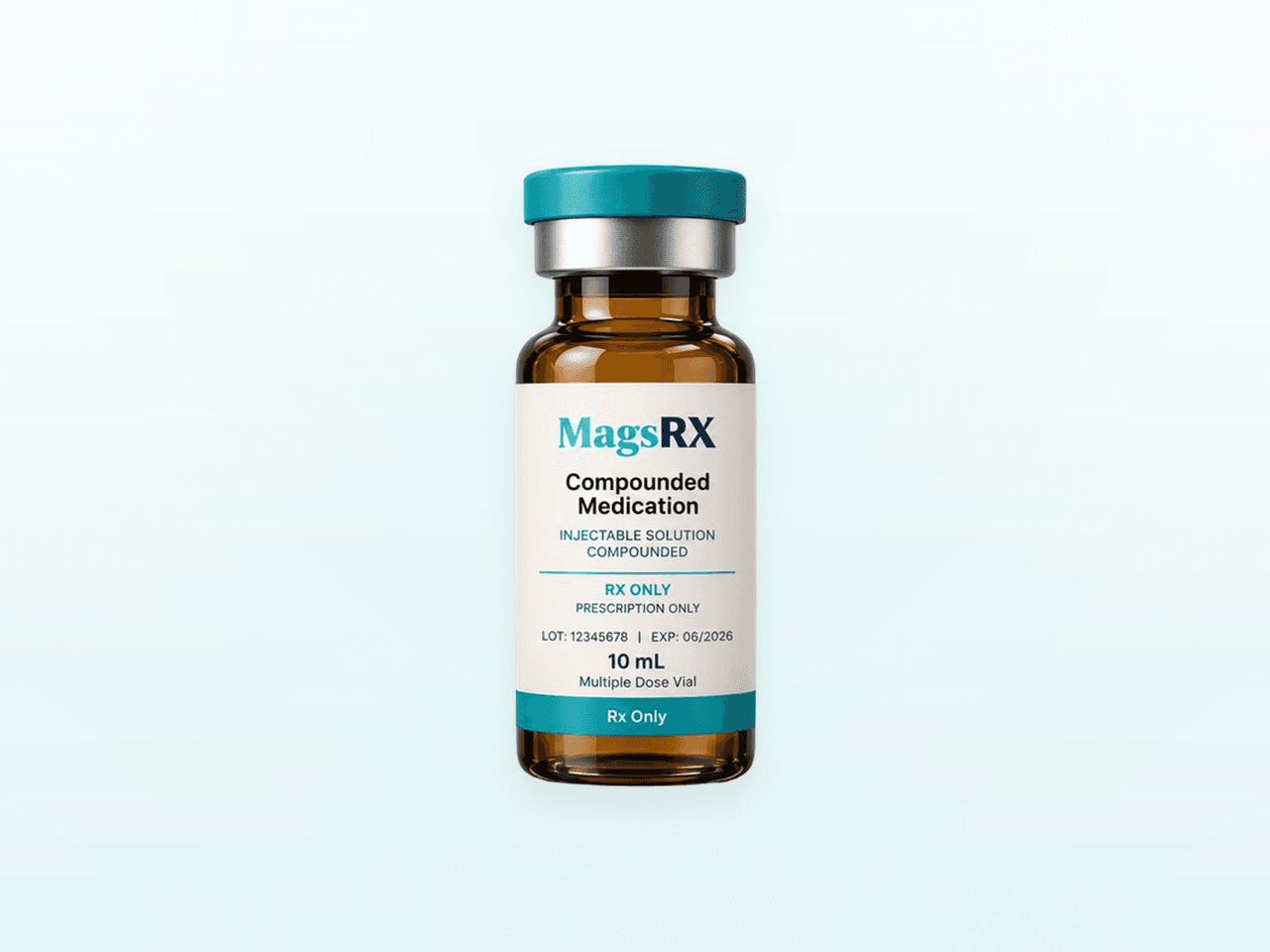
Complete Repair Stack
This is the widest-coverage combination on our peptide menu: four molecules that each cover a different axis of recovery. BPC-157 (Body Protection Compound) is studied for localized support of gut lining, tendon, and connective tissue; TB-500, a synthetic fragment related to Thymosin beta-4, is studied for systemic cell migration and soft-tissue flexibility that reaches beyond a single site; GHK-Cu, a copper-carrying tripeptide, is studied for dermal remodeling — collagen, elastin, and skin quality; and KPV, a short lysine-proline-valine tripeptide from the tail end of alpha-MSH, contributes the anti-inflammatory dimension the plainer BPC pairings leave out. Where our BPC-157 / TB500 stack covers repair and flexibility, and the three-peptide BPC / TB-500 / GHK-Cu adds skin, this four-peptide protocol is the only one in the family that also folds in KPV's studied calming of gut and skin inflammation. It is compounded and prescribed only when a licensed provider determines it is clinically appropriate for you.
Each of the four peptides covers a lane the others do not — the rationale for this stack is that BPC-157, TB-500, GHK-Cu, and KPV address repair, remodeling, and inflammation together rather than one at a time. Here is what each contributes.
BPC-157 + TB-500 — the repair pairing
BPC-157 is studied locally, with research pointing to angiogenic (VEGFR2 / nitric-oxide) and growth-factor signaling around a repairing tendon, ligament, or gut lining. TB-500, related to Thymosin beta-4, is an actin-binding peptide studied for supporting cell migration and soft-tissue flexibility more systemically — so this pairing spans both the concentrated site and the broader tissue around it, which is the base layer the other two peptides build on.
GHK-Cu — the copper-led skin lane
This tripeptide binds a copper(II) ion and is studied for delivering it to dermal fibroblasts and for its relationship to lysyl oxidase, the copper-dependent enzyme that cross-links collagen and elastin. It is the component that turns this stack toward skin firmness, texture, and matrix quality — a dermal-remodeling role neither BPC-157 nor TB-500 supplies on its own.
KPV — the anti-inflammatory tripeptide
KPV is the C-terminal lysine-proline-valine sequence of alpha-MSH, studied for dampening inflammatory signaling (including NF-kB pathways) in intestinal and skin tissue — without the pigment-driving melanocortin effects of the full hormone. It is the vector that sets this four-peptide stack apart from every BPC combination that lacks it, layering an inflammation lane over the repair and remodeling work of the other three.
Candidacy
A considered fit, not a funnel.
This four-peptide stack tends to suit people whose goals span more than one lane at once — someone working through a nagging soft-tissue issue who also wants support for gut or skin inflammation, and who would like skin-quality support folded into the same protocol rather than run separately. It is the maximal-coverage option in the BPC family, so it fits people who might otherwise consider stacking several peptides on their own; if your goal is narrowly one thing — soft-tissue support alone, say, or skin alone — a single peptide or a two-peptide BPC pairing may be the cleaner fit. A provider reviews your history to decide whether all four peptides are warranted for you.
- Adults with overlapping goals — soft-tissue recovery alongside gut or skin inflammatory concerns
- Those who want GHK-Cu skin and collagen support built into a BPC/TB-500 repair protocol rather than run separately
- People seeking the broadest coverage of the BPC family in one provider-directed course
- Anyone with an active or recent cancer diagnosis (BPC-157 and TB-500 involve angiogenic and cell-migration signaling)
- People with Wilson's disease or another copper-metabolism disorder, given the GHK-Cu component
- Anyone pregnant, breastfeeding, or with a known hypersensitivity to any peptide in the stack or its diluent
Expected Timeline
What to expect
Because this stack pairs the faster-window BPC-157/TB-500 work with the slower, remodel-on-a-timeline nature of GHK-Cu — plus KPV's inflammatory lane — protocols often run a concentrated early phase and then continue skin and anti-inflammatory support longer. Your provider sets the exact peptides, doses, routes, and duration.
- 01
Weeks 1-2
Initiation
Your provider establishes the protocol — often subcutaneous, with routes and timing tailored per component (KPV, for instance, may be dosed orally for gut-focused goals) — and confirms tolerability of the four-peptide combination before continuing.
- 02
Weeks 3-6
Active phase
The core window where BPC-157 and TB-500 pursue tissue and flexibility goals while KPV works the inflammatory lane. Many protocols hold a steady cadence here as you and your provider track how the target areas respond.
- 03
Weeks 6-12+
Remodel, taper & reassess
The BPC-157/TB-500 peptides are often wound down while GHK-Cu's dermal-remodeling role continues over a longer arc. Your provider reviews response and decides whether to taper, maintain, or stop specific components.
Response varies from person to person, and this is a compounded, provider-directed multi-peptide therapy. Your exact protocol — which peptides, at what doses, by which routes, for how long — is set and adjusted by your prescriber. The cadence above is illustrative, not a promise of any particular result.
The Science
Why clinicians reach for it.
The evidence for each of these four peptides is largely preclinical and early-stage, and there is no large human trial of the combination. We describe the direction of research honestly — no invented studies, no promised outcomes.
Four distinct research lanes
BPC-157 traces to a gastroprotective sequence and is studied for connective-tissue and GI repair; TB-500 relates to Thymosin beta-4 and actin-based cell migration; GHK-Cu is a well-characterized copper tripeptide tied to dermal-matrix quality; KPV is the anti-inflammatory C-terminal fragment of alpha-MSH. The rationale for combining all four is that these lanes complement rather than duplicate one another.
KPV — the differentiating component
KPV's research interest sits in calming inflammatory signaling in gut and skin tissue while avoiding the pigmentary and appetite effects of the full alpha-MSH molecule. It is the reason this four-peptide protocol is framed with an anti-inflammatory lane that the BPC / TB500 and BPC / TB-500 / GHK-Cu stacks do not have.
Not FDA-approved
None of these four peptides is an FDA-approved drug, and the combination is available only through compounding when a licensed provider deems it appropriate. It should be viewed as an emerging, supportive protocol — not an established treatment for any condition.
Our Standard of Care
Real transformation, with a friendly team that stands by you every step.
- 01.Provider-Supervised
- Licensed providers review your health profile and guide every treatment decision. You only move forward when a plan is right for you.
- 02.Personalized Plans
- GLP-1 and peptide protocols are titrated to your biology and your goals. No one-size-fits-all, no guesswork.
- 03.We Stand By You
- From eligibility review to ongoing check-ins, our care team supports you throughout your transformation — discreet shipping and secure messaging included.
Clinical Safety
No therapy is right for everyone.
What to know
Reported effects across these peptides are generally mild and most often localized to the injection site — redness, tenderness, or transient itching — with occasional lightheadedness or nausea. Because the GHK-Cu component delivers copper, providers dose with cumulative copper exposure in mind, which is a consideration this stack carries that copper-free BPC pairings do not. Human safety data on all four combined is limited, so report any new or persistent symptom to your provider promptly.
Contraindications
Not appropriate during pregnancy or breastfeeding, or for anyone with a known hypersensitivity to any component peptide or the diluent. Because BPC-157 and TB-500 involve angiogenic and cell-migration signaling, the stack is generally avoided in anyone with an active or recent malignancy. The GHK-Cu component makes it unsuitable for people with Wilson's disease or other copper-metabolism disorders. Share your full medical history — including any cancer history, liver conditions, and copper-containing supplements — so your provider can assess suitability.
MagsRX protocols are prepared by partner compounding pharmacies in the United States. Compounding pharmacies are regulated by both state boards and the FDA and have been part of American medicine since long before mass-manufactured drugs existed. The active ingredient is prepared per your protocol — supervised by your provider — and delivered direct to your door.
Frequently Asked
Questions worth asking before you begin.
It is the broadest of the three. BPC-157 / TB500 covers repair and soft-tissue flexibility. Adding GHK-Cu brings copper-led skin and collagen remodeling. This four-peptide stack goes one step further by including KPV — the alpha-MSH-derived anti-inflammatory tripeptide — so it is the only one of the group with an inflammation lane for gut and skin alongside repair, flexibility, and skin quality.
KPV is the short lysine-proline-valine sequence from the tail of alpha-MSH, studied for calming inflammatory signaling in gut and skin tissue without the pigment-driving effects of the full hormone. It contributes the anti-inflammatory dimension that the plainer BPC combinations don't have — which is the main reason someone would choose this fuller four-peptide stack over a repair-and-flexibility pairing.
No. None of these four peptides act on the GHRH axis or trigger growth-hormone release, which distinguishes the whole stack from GH peptides like Sermorelin, Ipamorelin / CJC-1295, or Tesamorelin. Their studied pathways are tissue repair, cell migration, copper-linked skin remodeling, and inflammatory signaling — not any systemic hormone effect.
Explore More
Other therapies to consider.
 Tissue Repair
BPC-157
A body-protection pentadecapeptide studied for how it may support the slow-healing places — a strained tendon, an irritable gut lining, a joint that lingers.
Learn more →- Recovery Stack
BPC-157 / TB500
A two-peptide recovery stack that pairs BPC-157's localized repair focus with TB-500's systemic reach — so support isn't confined to one strained spot but extends across the soft tissue that moves with it.
Learn more → - Tissue Repair
BPC-157 Acetate
The same BPC-157 pentadecapeptide, prepared as the acetate salt — the biocompatible counter-ion chosen for a clean compounded preparation that avoids residual TFA.
Learn more →
Begin
BPC-157 / GHK-Cu / KPV / TB500 begins with a short assessment.
A licensed provider reviews every order and prescribes only if it is clinically appropriate for you. Your therapy is prepared by a partner compounding pharmacy and delivered discreetly to your door.