Peptide · Recovery & Tissue Repair
BPC-157 Acetate
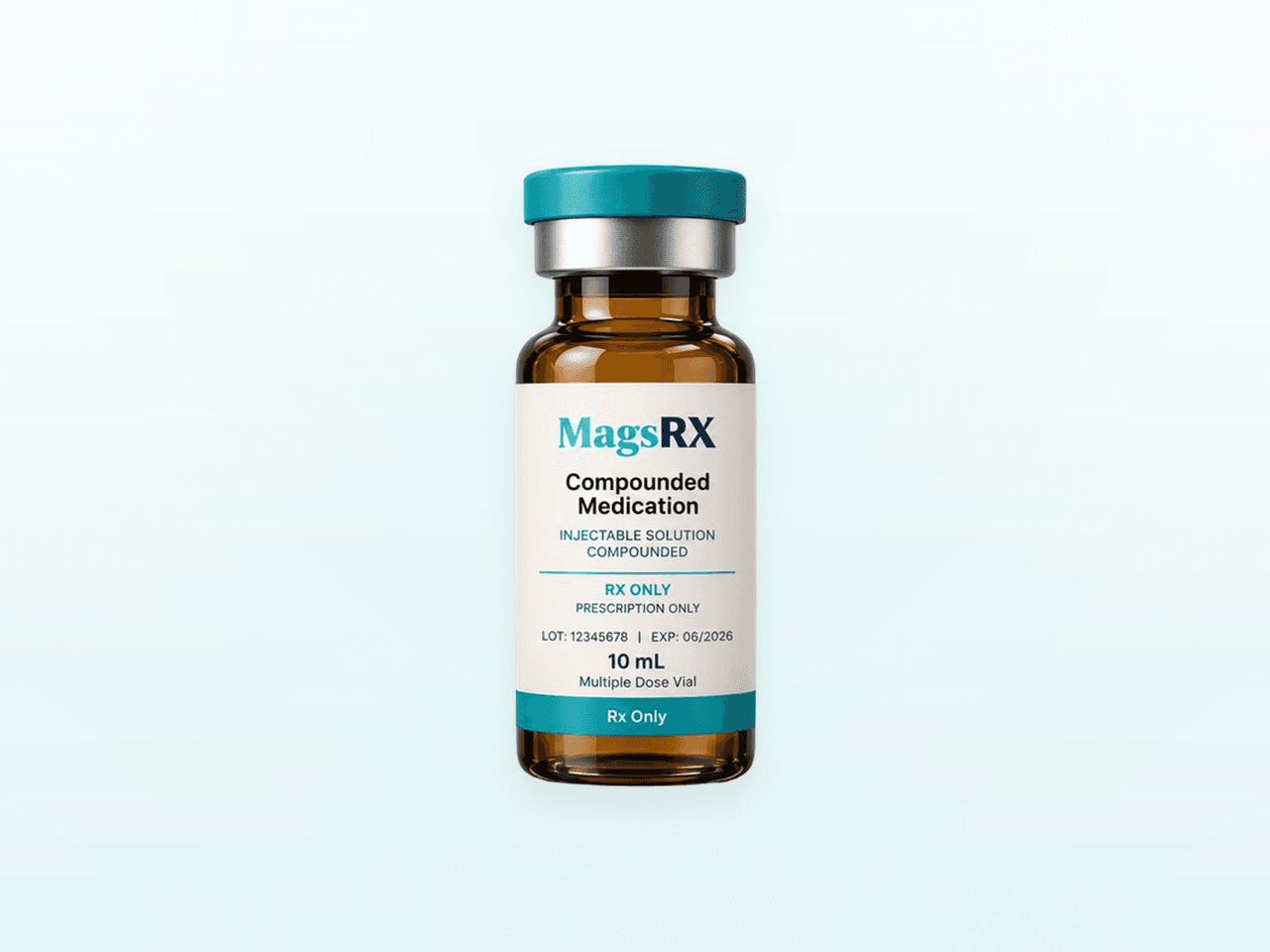
The same BPC-157 pentadecapeptide, prepared as the acetate salt — the biocompatible counter-ion chosen for a clean compounded preparation that avoids residual TFA.
Available by consultation
What it is
Tissue Repair
BPC-157 Acetate is the acetate-salt formulation of BPC-157 (Body Protection Compound) — the identical 15-amino-acid peptide, paired with acetate as its counter-ion rather than trifluoroacetate (TFA) or another salt. The peptide itself is unchanged, so the repair biology it is studied for is the same: connective tissue, the gastrointestinal lining, and the local signaling that helps a strained or irritated area rebuild. What the acetate form changes is the preparation, not the mechanism — acetate is a gentle, physiologically familiar counter-ion favored in compounding for a cleaner salt profile and predictable handling. It is a compounded therapy, prescribed only when a licensed provider determines it is clinically appropriate for you.
The acetate salt dissolves and dissociates into the very same BPC-157 peptide once reconstituted — so the mechanism below is BPC-157's, unchanged. What acetate contributes sits before the biology: the counter-ion that ships with the powder and how cleanly it goes into solution.
Acetate as the counter-ion
Synthetic peptides are isolated as a salt, and the counter-ion that comes along matters for the finished preparation. BPC-157 Acetate uses acetate — a small, biologically ordinary ion the body already handles — instead of trifluoroacetate left over from some purification methods. In solution the acetate simply dissociates, leaving the identical BPC-157 peptide to act; the salt choice is about the quality and predictability of the preparation, not a different drug.
Angiogenic & growth-factor signaling
Once dissolved, the peptide behaves as BPC-157 does: early research points to interaction with the VEGFR2 and nitric-oxide pathways behind new microvessel formation, and to influence on growth-factor receptors and fibroblasts — the cells that lay down the collagen scaffolding a healing tendon or ligament depends on.
Gut-lining & gut-brain protection
Because BPC-157 traces to a gastroprotective sequence, much of the scientific attention lives in the GI tract — the mucosal lining and gut-brain signaling axis. The acetate form carries this same focus; it does not add or subtract any pathway, and it has no parallel among the growth-hormone peptides on this menu.
Candidacy
A considered fit, not a funnel.
BPC-157 Acetate suits the same person BPC-157 does — an active adult working through a nagging soft-tissue issue, or someone focused on gut resilience — with the added consideration of preferring an acetate-salt preparation. Choosing between salt forms is a formulation detail your provider and pharmacy weigh, not a change in what the therapy is for. It supports recovery rather than replacing surgical, orthopedic, or gastroenterology care, and a provider reviews your history to decide whether it fits your goals.
- Adults recovering from a tendon, ligament, or joint strain who want an acetate-salt preparation
- Those focused on gut-lining resilience and GI comfort
- People who prefer the acetate counter-ion over a residual-TFA peptide salt
- Anyone with an active or recent cancer diagnosis (BPC-157's angiogenic signaling is a theoretical concern)
- People who are pregnant or breastfeeding
- Anyone with a known hypersensitivity to the peptide or diluent
Expected Timeline
What to expect
Because the active peptide is BPC-157, the acetate form is run the same way — a focused repair course concentrated during an active healing window, then wound down. The salt choice affects the pharmacy's preparation, not your dosing calendar.
- 01
Weeks 1-2
Initiation
Your provider establishes a daily protocol — often subcutaneous, sometimes dosed near the area of concern, or oral for gut-focused goals — using the acetate-salt preparation, and confirms tolerability before continuing.
- 02
Weeks 3-6
Active repair
The core window where connective-tissue or gut-support goals are pursued. Many protocols hold a steady daily cadence here while you and your provider track how the target area responds — identical to how base BPC-157 is run.
- 03
Weeks 6-8+
Taper & reassess
Rather than continuing indefinitely, courses are commonly wound down and reassessed. Your provider decides whether a maintenance approach, a pause, or a stop makes sense.
Response varies from person to person, and BPC-157 Acetate is a compounded, provider-directed therapy. Your protocol, route, and duration — and the choice of salt form — are set and adjusted by your prescriber and pharmacy; the cadence above is illustrative, not a promise of any particular result.
The Science
Why clinicians reach for it.
The evidence base is BPC-157's — largely preclinical and early-stage — since acetate and other salt forms deliver the same peptide. We describe the direction of research honestly, and are clear that the acetate distinction is one of preparation, not proven clinical superiority.
Rooted in a protective protein
BPC-157 corresponds to a partial sequence of a protein found in gastric juice — the reason so much research attention has historically centered on gastrointestinal protection and mucosal integrity. The acetate salt does not alter this sequence.
Why acetate rather than another salt
In peptide chemistry the counter-ion is a formulation choice: acetate is widely used because it is biologically benign and avoids residual trifluoroacetate that can accompany certain purification routes. This is a well-established preference in compounding — not a claim that acetate outperforms BPC-157 clinically, which has not been demonstrated in head-to-head human trials.
Not FDA-approved
BPC-157 in any salt form, including acetate, is not an FDA-approved drug and is available only through compounding when a licensed provider deems it appropriate. It should be viewed as an emerging, supportive therapy — not an established treatment for any condition.
Our Standard of Care
Real transformation, with a friendly team that stands by you every step.
- 01.Provider-Supervised
- Licensed providers review your health profile and guide every treatment decision. You only move forward when a plan is right for you.
- 02.Personalized Plans
- GLP-1 and peptide protocols are titrated to your biology and your goals. No one-size-fits-all, no guesswork.
- 03.We Stand By You
- From eligibility review to ongoing check-ins, our care team supports you throughout your transformation — discreet shipping and secure messaging included.
Clinical Safety
No therapy is right for everyone.
What to know
Because the acetate form delivers the same peptide, reported effects mirror BPC-157: generally mild, and may include irritation, redness, or discomfort at the injection site, and occasional lightheadedness or nausea. Acetate is a physiologically common ion and is not expected to add its own effects at these amounts. Because human safety data is limited, report any new or persistent symptom to your provider promptly.
Contraindications
Not appropriate during pregnancy or breastfeeding, or for anyone with a known hypersensitivity to the peptide or diluent. Given BPC-157's angiogenic and growth-factor signaling, it is generally avoided in anyone with an active or recent malignancy — the same caution applies regardless of salt form. Share your full medical history, including any cancer history, so your provider can assess suitability.
MagsRX protocols are prepared by partner compounding pharmacies in the United States. Compounding pharmacies are regulated by both state boards and the FDA and have been part of American medicine since long before mass-manufactured drugs existed. The active ingredient is prepared per your protocol — supervised by your provider — and delivered direct to your door.
Frequently Asked
Questions worth asking before you begin.
No — it is the same body-protection pentadecapeptide. The only difference is the counter-ion it is paired with: acetate rather than trifluoroacetate or another salt. Once reconstituted, the acetate dissociates and the identical BPC-157 peptide is what acts, so the studied repair biology is the same.
Acetate is a biologically familiar, benign counter-ion, and acetate-salt preparations avoid the residual trifluoroacetate (TFA) that can come from some purification methods. It is a common formulation preference in compounding for a cleaner, more predictable preparation — a pharmacy and provider decision, not a change in what the therapy does or a claim of better results.
No. Like BPC-157, the acetate form does not act on the GHRH axis or trigger growth-hormone release. Its studied pathways are angiogenesis, growth-factor signaling, and gut protection — localized repair rather than any systemic hormone effect, which is what sets it apart from the GH peptides on our menu.
Explore More
Other therapies to consider.
 Tissue Repair
BPC-157
A body-protection pentadecapeptide studied for how it may support the slow-healing places — a strained tendon, an irritable gut lining, a joint that lingers.
Learn more →- Recovery Stack
BPC-157 / TB500
A two-peptide recovery stack that pairs BPC-157's localized repair focus with TB-500's systemic reach — so support isn't confined to one strained spot but extends across the soft tissue that moves with it.
Learn more → - Complete Repair Stack
BPC-157 / GHK-Cu / KPV / TB500
Our broadest repair stack — four peptides that pair BPC-157/TB-500 tissue and soft-tissue support with GHK-Cu copper-led skin remodeling and KPV's anti-inflammatory lane.
Learn more →
Begin
BPC-157 Acetate begins with a short assessment.
A licensed provider reviews every order and prescribes only if it is clinically appropriate for you. Your therapy is prepared by a partner compounding pharmacy and delivered discreetly to your door.